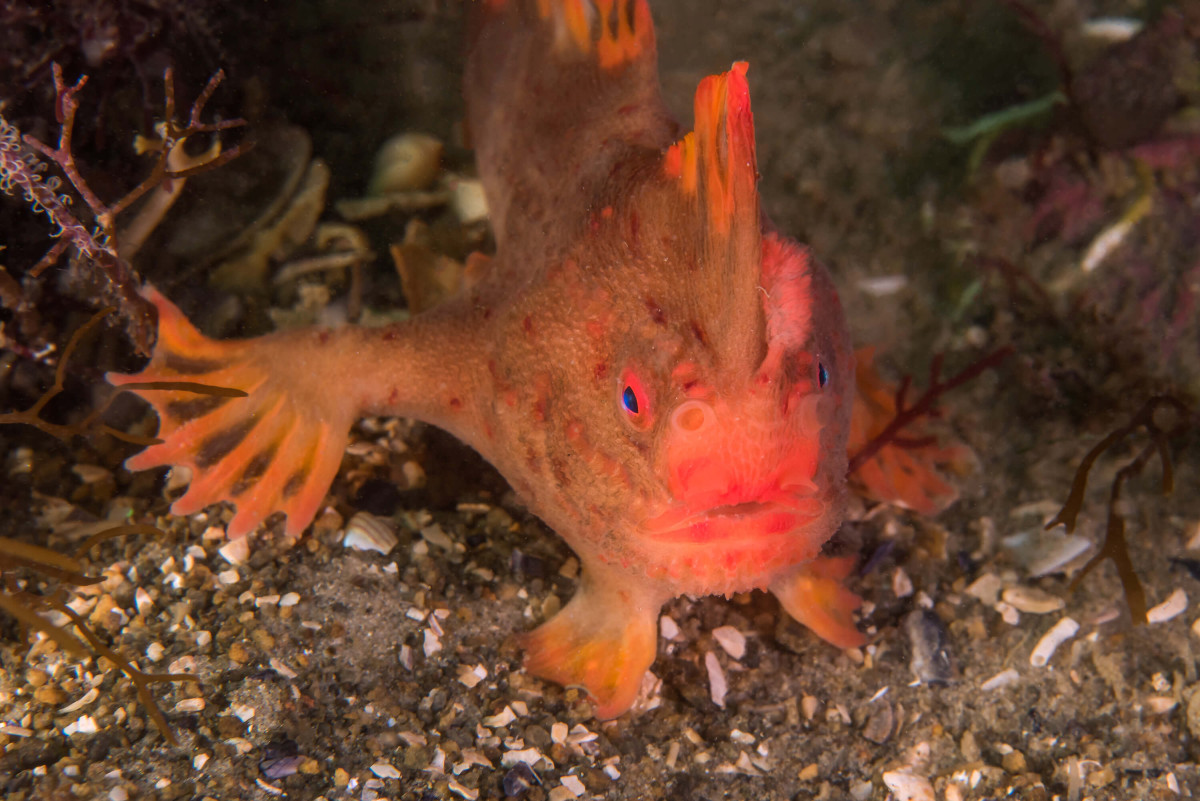
Tasmania's first seagrass restoration nursery was officially launched yesterday, in a vital step towards
restoring healthy habitat to help secure the future of the Critically Endangered red handfish.
Based at the University of Tasmania’s Institute for Marine and Antarctic Studies (IMAS) in Taroona, the
nursery was developed with support from the Australian Government's Saving Native Species program.
“Seagrass meadows are an incredibly important marine ecosystem – and in Tasmania, they also provide crucial habitat for the last remaining population of red handfish,” said IMAS marine ecologist, Dr Jemina Stuart-Smith who co-leads the seagrass restoration program at IMAS with Associate Professor Andrew Trotter.
Lead IMAS postdoctoral fellow, Elizabeth Andrews, said these ecosystems also play an important role in improving water quality, providing essential habitat and nursery grounds for fish and invertebrates, offering coastal storm protection, and supporting biodiversity and food webs.
“However, they face significant threats from coastal development, urban pollution, invasive and pest species, as well as climate change,” she said.
“Historical mapping estimated Tasmania lost nearly a quarter of its seagrass between 1950 and 1990.
Over the last 30 years significant declines have continued to be observed, including at sites critical to the survival of the red handfish.”
The nursery will advance seagrass restoration capability in Tasmania and beyond, including developing techniques for seed collection, storage and propagation.
“We will also be working with our local community on habitat restoration trials in the wild,” Dr Stuart-Smith said.
“Importantly, it will provide the critical infrastructure and expertise, and build the knowledge required for adaptive management of our marine ecosystems under ever-increasing human impacts, contributing to a growing conservation toolkit that underpins scalable, evidence-based marine restoration.”
The investment in this seagrass restoration nursery supports the Australian Government's Threatened Species Action Plan 2022–2032, helping safeguard species at greatest risk of extinction.
“The establishment of this seagrass nursery strengthens the capacity to restore habitat for the Critically
Endangered red handfish, and supports broader research into developing cultivation, out-planting and climate-resilient restoration approaches that are critical in our ability to provide climate-ready approaches to managing these ecosystems,” said IMAS Ecology & Biodiversity Centre Head, Professor Vanessa Lucieer.
The work builds on the broader red handfish recovery program, generously supported by the Foundation for Australia's Most Endangered Species and valued partners at the Department of Natural Resources and Environment Tasmania (NRE Tas), Friends of the Red Handfish, and the Handfish Conservation Project.
“Together, we're giving this little creature, and the habitat it depends on, a better chance of survival,” said Associate Professor Andrew Trotter, who co-leads the program.
“Through a combination of conservation aquaculture and ecological studies, we will also be improving our preparedness for the climate change and human impacts on Australia’s marine ecosystems.”
The seagrass restoration nursery is funded by a Saving Native Species grant through the Australian
Government’s Department of Climate Change, Energy, the Environment and Water (DCCEEW).